
From 20 July to 2 August, Food Indaba 2026 brought people together across Cape Town to explore a question that is at once obvious and easy to overlook: what happens when we understand water and food as parts of the same system?
This year’s theme — Rivers, Oceans, Aquifers and Rainfall (ROAR) — provided a way into that question. Across conversations, walks, meals, workshops, market encounters, masterclasses and the Water and the Food System Conference, researchers and policymakers met farmers, traders, activists, entrepreneurs, chefs, writers, young people and others whose lives and work offer very different ways of understanding the food system.
What emerged was not a single answer. Instead, the programme repeatedly showed how questions about water quickly become questions about history, identity, livelihoods, dignity, power, culture and our capacity to adapt to change.
Water is never only about water
The Water and the Food System Conference, co-hosted with the DSTI-NRF Centre of Excellence in Food Security, began with Cape Town’s own experience of Day Zero but moved well beyond the management of a scarce natural resource.
Tauriq Jenkins of the Goringhaicona Khoi Khoin Traditional Indigenous Council opened the conference by locating water within the much longer history of settlement, dispossession and indigenous heritage in the Western Cape. Deshni Pillay, Head of the Nature, Climate and Energy portfolio at UNDP South Africa, placed the conversation within a wider global polycrisis.
Community activists and practitioners brought another perspective: the ways people already organise, share resources and build systems of mutual support when formal systems do not adequately meet their needs.
Across these conversations, water became inseparable from questions about who has access to resources, whose knowledge counts, how communities respond under pressure and whether adaptation means simply making existing systems more efficient or being prepared to change them more fundamentally.
The entire conference was excellent. It was deeply moving and insightful. It was one of the most profound events I’ve attended in ages.
Gareth Haysom, African Centre for Cities (UCT)
The food system looks different when you walk through it
Some of the most revealing conversations happened away from conference rooms.
Food Indaba walks took participants through different parts of Cape Town’s food system: urban agriculture in Langa, food histories in the CBD, farms at Oranjezicht City Farm and Lerotholi Food Garden, and the dense formal and informal food economy of Bellville.
The Bellville walk made several tensions particularly visible. Formal shops and informal traders were not operating as two separate food systems. They watched and responded to one another. Products, customers and trading practices continually changed. The market was inventive, dynamic and highly responsive. It was also vulnerable.
Several participants reflected that they had long wanted to explore markets like Bellville’s but had not previously known how to do so or felt sufficiently safe to enter them. Food Indaba did not resolve that contradiction. It created an opportunity to experience it together and to understand the market through people who work within it.
That encounter mattered because food systems are experienced differently depending on where we stand within them.
Food carries memory, identity and belonging
The programme also approached the food system through culture.
At World of Mouth dinners, food became a way of exploring water, memory, health, migration and heritage around a shared table.
For Wetlands Within, Leigh and Lerato Waters-Maine of Mpintshi Yum developed a four-course experience connecting water, indigenous ingredients, memory and gut health. A carefully composed soundscape and spoken-word poetry accompanied the meal, while the long-table format allowed conversations to form between people who might otherwise never have met.
For Mosotho in the City, chef Zandile Finxa of The Sorghum Agenda used the Basotho New Year and sorghum as points of departure for a harvest meal that connected grain, tradition, place and contemporary city life.
A literary conversation approached similar questions through writing. Stories about food opened into questions of gender, dispossession, identity, home and what people carry with them when circumstances force them to leave one place and make another.
These experiences reminded us that food is not simply a collection of commodities moving through a supply chain. It carries histories, attachments and ways of knowing that conventional food-system analysis can easily miss.
Emerging enterprises need more than somewhere to sell
Food Indaba 2026 also introduced MRKTPLC, a two-day working expo at Makers Landing involving 14 emerging local agri-food processing businesses, the majority women- and youth-owned.
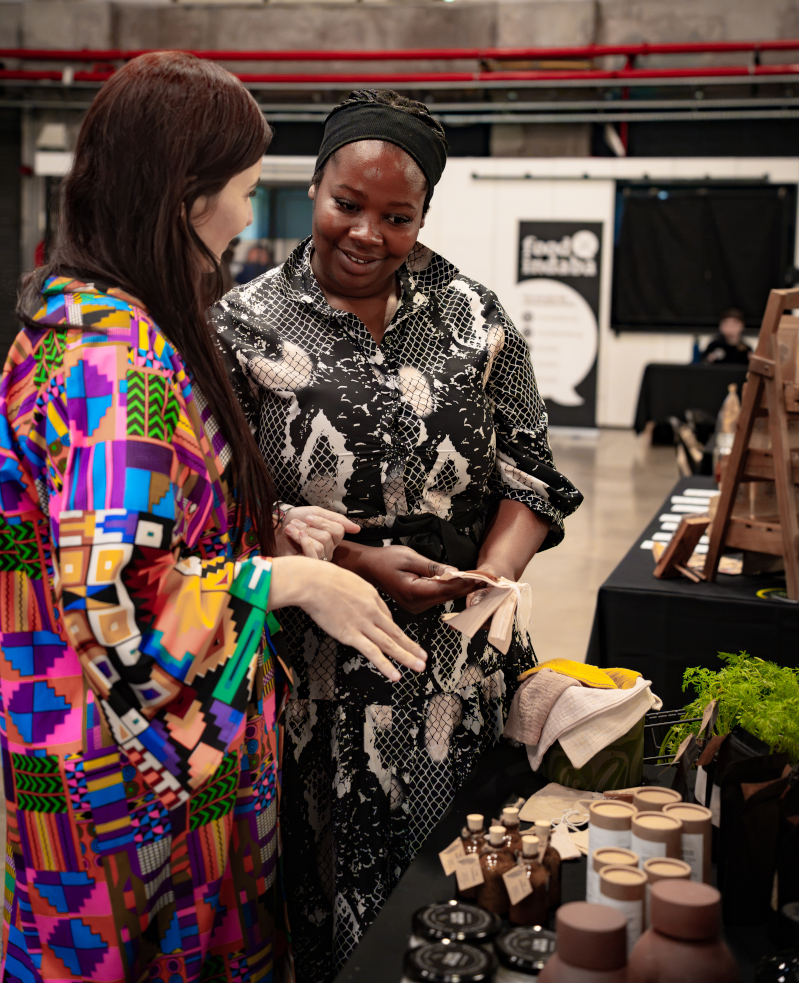
The participating enterprises were given dedicated spaces to present their products, alongside opportunities for short pitches on the Spotlight Stage, multimedia storytelling and engagement with buyers, chefs, media and other people across the food ecosystem.
The experiment produced an important piece of learning. Direct retail trading was weaker than we had hoped. But the Spotlight Stage, networking, business-to-business connections and opportunities for entrepreneurs to tell their stories proved particularly valuable. That changes how we think about the opportunity. Simply giving an emerging enterprise a stall does not necessarily create meaningful market access. Enterprises may benefit more when a market or public event forms part of a longer process: preparing beforehand, strengthening how they understand and present their businesses, meeting relevant people in a deliberately structured environment, receiving feedback and then following those relationships afterwards. That learning will inform how MRKTPLC develops from here.
Young people approached scarcity differently
Some of the youngest Food Indaba participants encountered the water question through experimentation.
At the Cape Town Science Centre, Hack the Kitchen: Kids Water Lab explored what desert plants and indigenous KhoeKhoe knowledge can teach us about finding and conserving water in dry environments.
Teenagers participating in a Zero-Water Cooking Jam at Food Jams were challenged to cook using the moisture already contained in ingredients rather than relying on water from a municipal tap.
These were playful activities, but they also asked an important question: what changes when scarcity becomes a design condition rather than only a problem to discuss?
What we take forward
Food Indaba is deliberately made up of very different kinds of encounters.
A conference can bring evidence and competing perspectives into conversation. A walk can make visible something that cannot be understood from a presentation. A meal can open questions of identity and memory. A market can test whether an idea about enterprise opportunity actually works. A workshop can give young people permission to experiment. The value lies partly in what happens when these different experiences begin to speak to one another.
ROAR showed us that water cannot be separated neatly from food, just as neither can be separated from history, culture, land, infrastructure, markets, livelihoods or power.
It also reinforced something more practical: complex food-system challenges are not likely to be understood—much less addressed—from a single vantage point. We need opportunities for people who encounter the system differently to meet one another, experience unfamiliar parts of it, test ideas together and carry what they learn into what they do next.
That is the work Food Indaba will continue to develop from what we learned together in 2026.
 SA Urban Food & Farming Trust