
Following the success of the inaugural Open Streets event, the SA Urban Food & Farming Trust (SAUFFT) was invited to participate in the Open Streets Experiments: Lerotholi Ave Sundays on 30 November. The platform allowed us to showcase work across our community programmes in Langa, Khayelitsha, Mitchells Plain, and Gugulethu.
At the event, we were honoured to host Cape Town Mayor Geordin Hill-Lewis on a guided tour led by Mpilo Ngcukana of 16 on Lerotholi Gallery and the Masakhe Foundation, which provided a valuable opportunity to showcase the impact of our work and highlight the collaborative partnerships, including with the City of Cape Town and its committed departments, that have been central to the transformation currently underway in Langa.
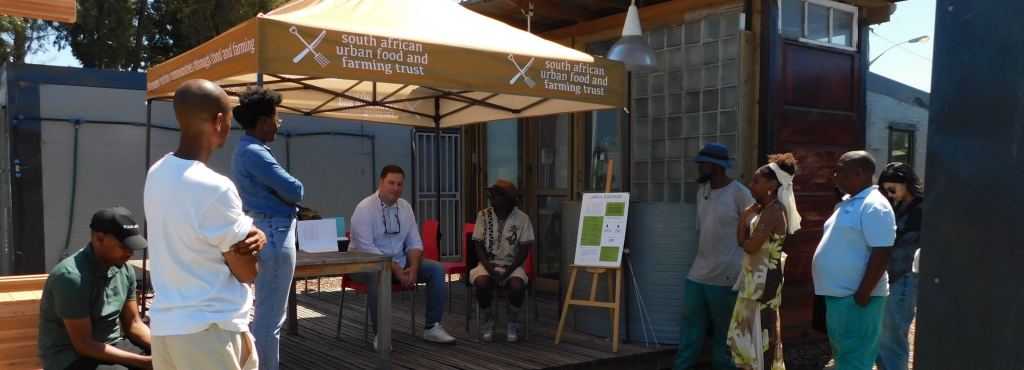
Showcasing Community-Led Food System Innovation
The tour began with Tea with the Farmer, hosted by Mzi Mashicila from the Lerotholi Community Garden. He presented his upgraded herb garden (developed through the Re: Build project in collaboration with the University of Cape Town, and 16 on Lerotholi) and served herbal teas, highlighting the range and quality of his locally grown products.
SAUFFT Programme Manager Rirhandzu Marivate introduced our broader mission to the Mayor and guests, emphasising our commitment to community-led resilience.
“Our work is fundamentally about creating systems where communities lead, innovate, and drive change,” said Rirhandzu. “Through the Agrihub initiative, we support collective action among urban farmers across 36 gardens in Langa and are expanding similar approaches across Khayelitsha, Mitchells Plain, and Gugulethu.”
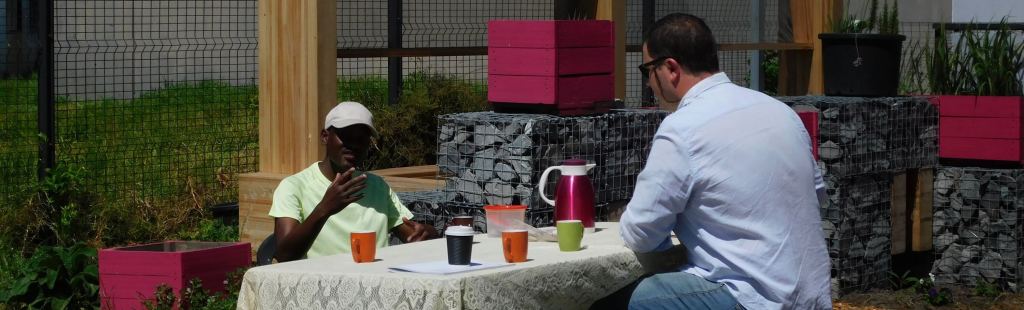
Demonstrating Circularity Through AfriFOODLinks
The tour also highlighted the AfriFOODLinks initiative, an ICLEI Africa–coordinated partnership aimed at strengthening food environments in African cities. In Cape Town, SAUFFT works closely with the City to improve informal trading conditions through skills development, infrastructure improvements, food safety support, and circular economy interventions.
A practical example is the Biobin at the Langa Agrihub, an in-vessel system that converts organic and cooked waste, including meat, into compost for local farmers. Developed through collaboration between Waste-ED, the City, and local waste entrepreneurs, the Biobin illustrates how circular systems can be embedded within community food economies.
Transforming the Smiley Market Through Collaboration
The tour concluded at the Smiley Market, where substantial upgrades now demonstrate the impact of strong partnerships. Improvements include the clearance of a 400-tonne waste stockpile, improved storage facilities, a waste depot, sheep-head ovens developed by Burro, and food safety compliance kits.
With the Mayor present, traders received business licences and Certificates of Acceptability, an important milestone in formalising and strengthening their enterprises.
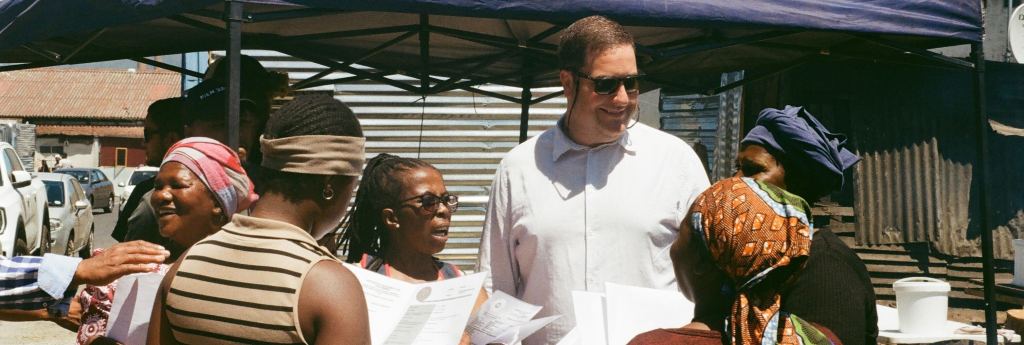
Reflecting on the progress, Guy from Ranyaka, project manager for the Smiley and Albert Luthuli Street Traders initiative, shared the journey behind the transformation.
“When we first arrived, this site held more than 400 tons of waste,” Guy said. “To build something meaningful, we needed a solid foundation. Today, everything you see, the ovens, the waste depot, the lighting kits by Ener-G-Africa, the business training, exists because traders, partners, and City teams committed to a shared vision.”
He highlighted the collaborative model that underpins the work, from clean-wood supply chains to grease-trap innovation, business training supported by Nedbank’s Consumer Financial Education programme, and solar lighting kits supplied by a local women-led manufacturer.
“We can feel far apart, even at odds, but this project proved that a common goal brings us together,” he added. “We want resilient urban food systems made of businesses that thrive economically while keeping their township culture and social value alive.”
The Smiley Market transformation reflects deep collaboration between SAUFFT, Ranyaka, Yes& Studio, Waste-ED, Burro, and multiple City departments, including Resilience and Future Planning, Environmental Health, Area Economic Development, Road Infrastructure Management, Urban Planning & Design, and Human Settlements, to name a few.

A Model for People-Centred Urban Transformation
The Lerotholi Ave Open Streets Experiment demonstrates the power of public spaces that celebrate local culture, food, and enterprise. For SAUFFT, the event reaffirmed the value of community agency, circularity, and partnerships that allow local farmers and traders to thrive.
As Cape Town advances inclusive urban development models, initiatives like this one show that when communities are centred, resilience grows, and collective transformation becomes possible.
Lerotholi Ave Open Streets will take place on the last Sunday of each month until April 2026.
 SA Urban Food & Farming Trust