
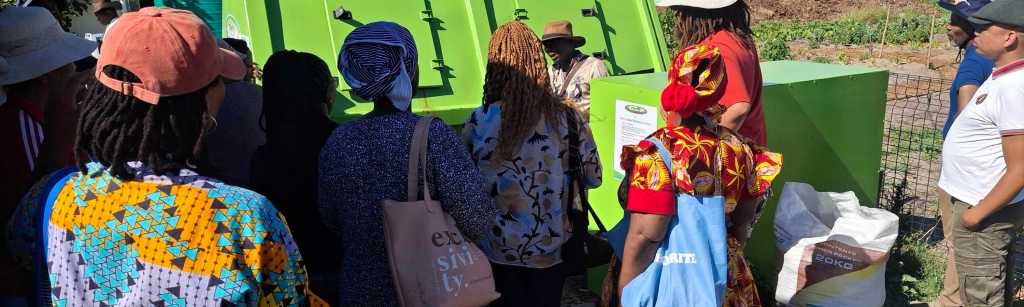
In November, a diverse group of City officials, community members, circular economy innovators, and local partners gathered in Langa for a full-day learning journey marking the beginning of the Langa Waste Forum. More than an educational trip, the outing became a moment of relationship-building, shared reflection, and collective visioning for what a cleaner, more circular, community-led Langa could be.
The outing came at a time when Langa is piloting new waste-to-resource systems through the AfriFOODLinks Smiley Market Waste Diversion Pilot led by WasteED. While the pilot tests infrastructure, it is ultimately the community that must shape the long-term system. The Waste Forum is emerging as that backbone, an inclusive space for traders, waste workers, City departments, farmers, gardeners, NGOs, and residents to plan together and co-design waste solutions grounded in local realities.

A Day of Learning Across Systems
The journey began with a walk-through of the Langa AgriHub BioBin System, where participants saw organic waste processed on-site. The BioBin immediately sparked excitement, with many imagining how similar systems could multiply across Langa to reduce dumping, support composting, and return nutrients to the soil. Participants were eager to see what insights the pilot would reveal.
From there, the group travelled to the Stellenbosch landfill site. City officials noted how differently Stellenbosch operates, more flexible in accommodating waste users, more accessible, and using AI technology to support worker efficiency without replacing jobs. The visit inspired reflection on what Cape Town might adapt or improve in its own systems.
The final stop was the Sustainability Institute, where circularity is built into daily operations. Participants explored small-scale organic waste systems and low-waste campus practices. Farmers were especially intrigued by the indigenous plant gardens and began discussing which species could serve as cover crops back in Langa. Others reflected on how the Institute’s integrated approach to waste, ecology, and community might guide future initiatives at home.
Co-Creating the Langa Waste Council
The day ended with a collaborative workshop to shape the purpose and early agenda of the Langa Waste Forum. City officials, informal traders, farmers, recyclers, artists, ECD representatives, PROs, and residents all contributed their experiences and ideas. The group also identified missing voices and discussed how to bring them into the process.
What stood out most was the sense of inclusion. Many traders shared how meaningful it felt to be part of decision-making rather than simply consulted. Several expressed joy at being “tourists for a day”, visiting Stellenbosch and the Sustainability Institute instead of always being the community visited by outsiders.
Shared Challenges, Shared Possibilities
Participants openly named the challenges they face: limited behaviour change, fragmented community voices, inadequate infrastructure, inconsistent waste education, and siloed communication between the City and residents. Yet the outing also revealed deep strengths, community accountability, strong local networks, City expertise, private sector interest, and a growing ecosystem of farmers, traders, upcyclers, recyclers, ECD centres, and residents committed to a cleaner Langa.
Across these reflections, a common theme emerged: the Waste Forum could become the connective tissue that unites fragmented efforts, bridges policy and practice, and ensures waste solutions are co-created rather than imposed.
A Vision for a Circular, Community-Led Langa
During the creative mapping session, participants imagined what a waste-to-resource Langa could look like. They pictured cleaner and safer open spaces, restored natural environments, circular markets, upcycling hubs, more composting sites, and new green livelihoods. They envisioned local representatives helping process community concerns, better communication with City departments, and practical systems for reuse, recycling, organic waste, and behaviour change.
What emerged was a shared belief that Langa can become a model of circularity, so long as systems are designed with the community at the centre.

A Perspective from the SA Urban Food & Farming Trust
Rhandzu Marivate, Programmes Manager at SAUFFT, reflected on the significance of the outing:
“The outing represented a fundamental milestone in the AfriFOODLinks project and in how we shift our approach to urban challenges. By bringing together City officials, informal traders, residents, and other waste actors into the same space, not just to listen but to co-create, we are progressing towards finding common ground to address waste challenges and uncovering opportunities in waste as a resource within Langa. The Langa Waste Forum is a real opportunity to strengthen relationships and foster a shared sense of ownership over Langa’s circular waste future.”
Guy Campbell, AfriFOODLinks Langa Co-Design Lead, Ranyaka Community Transformation added:
“The Langa Waste Forum outing was truly a highlight of the waste programme and the AfriFOODLinks Langa interventions as a whole. Having stakeholders from local government, the private sector, civil society, and Langa locals together workshopping under the trees of the Sustainability Institute was a sight to behold. Making real change becomes possible when stakeholders from across the board come to the table. It is exciting to see the progress made here, and it bodes well for the future of using creative, entrepreneurial solutions to promote integrated waste management.”
Looking Ahead
This outing laid the groundwork for a long-term, participatory governance structure that will carry Langa’s circular vision forward. Membership forms are being circulated, and the first official Waste Forum meeting is scheduled for January 2026, where the Forum’s mission, vision, and structure will be formally adopted. An action plan will follow, guided by the ideas and relationships strengthened during this journey.
 SA Urban Food & Farming Trust