
The publication of Sustaining Urban Food Gardens for Community Resilience: A Case Study of the Langa Agrihub arrives at a critical moment, one in which compounding risks, cascading systemic failures, and escalating climate uncertainty are reshaping how societies must think about resilience. As global policy debates continue to centre technocratic, expert-driven models of risk governance, the Langa Agrihub offers a powerful counter-narrative: that decentralised, place-based interventions can generate distributed resilience in ways formal governance systems simply cannot.
Written by Kurt Ackermann (CEO of the South African Urban Food and Farming Trust) and Tamsin Faragher (Principle Resilience Officer at the City of Cape Town), the case study sits as a chapter within a broader volume that argues, persuasively, that expert-driven approaches to mitigating the impacts of climate variability are inadequate in the face of escalating, interlinked crises. The book challenges the dominance of narrow, centralised decision-making frameworks and calls for a shift towards inclusive, participatory risk governance, where scientific knowledge is integrated with organisational expertise and the lived experience of communities.
It is precisely within this intellectual terrain that the Langa Agrihub emerges as a model that both embodies and advances this shift.
Beyond Food Security: A Platform for Civic Participation and Local Agency
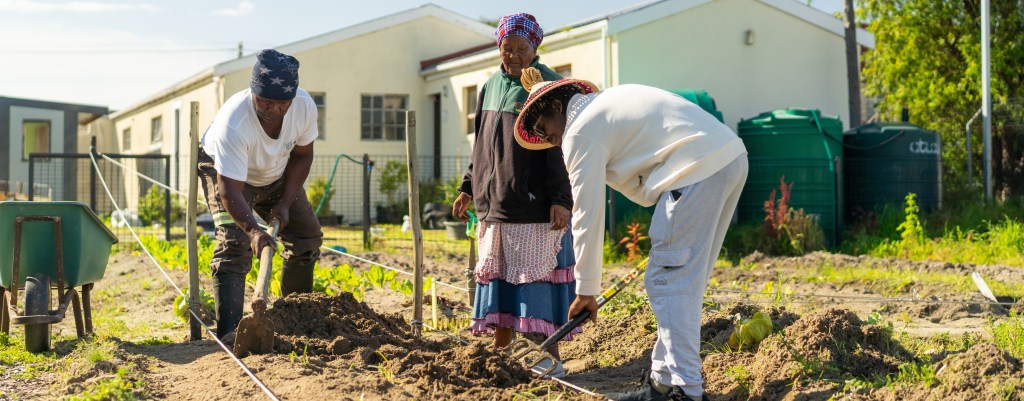
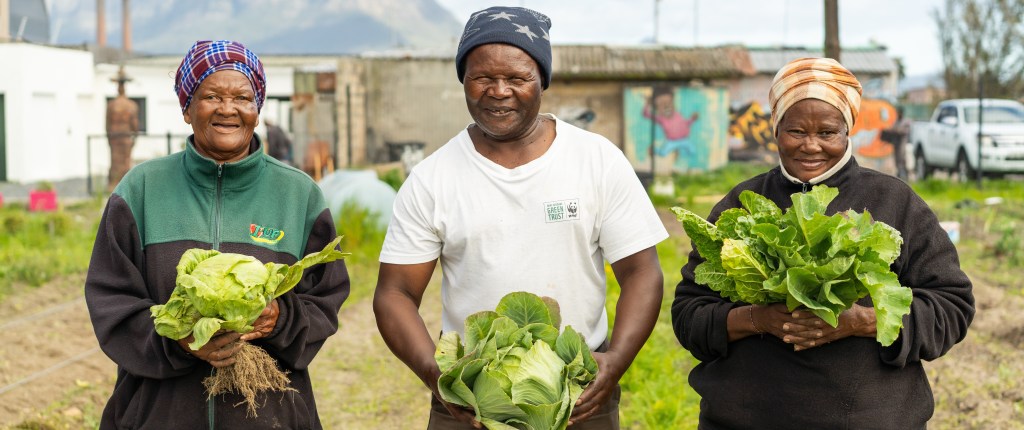
Located in Langa, one of Cape Town’s oldest townships shaped by racialised spatial planning and ongoing socio-economic exclusion, the Langa Agrihub supports a network of more than 250 urban farmers across over 30 gardens. While community food gardens are often understood narrowly as food security projects, the chapter demonstrates that their primary value lies elsewhere: in building the social infrastructure necessary for communities to mitigate and adapt to intersecting stresses.
Through participatory implementation, evaluation, and reflection over three years, the study shows that the Agrihub contributes not only to economic livelihoods, biodiversity, and climate adaptation, but also to mental and physical wellbeing, democratic engagement, and strengthened local agency. Access to inputs, infrastructure, knowledge exchange, and market connections are essential elements, but the deeper value lies in the Agrihub’s role as a convening platform, a space for civic participation, collective learning, and social cohesion.
In a context where water scarcity, energy insecurity, and environmental degradation intersect with economic marginalisation, it is precisely these forms of grounded, collective capability that enable communities to adapt and respond.
A Corrective to Technocratic Adaptation Paradigms
At the core of the argument is a profound challenge to traditional, technocratic approaches to adaptation. The Langa Agrihub illustrates that effective decision making under climate uncertainty cannot rely solely on institutional expertise, predictive modelling, or centralised governance structures. Instead, it foregrounds social infrastructure, informal networks, and lived experience as central to how resilience is actually produced in contexts of constrained institutional capacity.
This shift mirrors the broader objectives of the book: to break down disciplinary silos, deepen stakeholder engagement, and embrace transdisciplinary collaboration. Crucially, it argues for integrating scientific, organisational, and experiential knowledge, rather than assuming that risk governance must be driven from the top down.
In doing so, the Langa Agrihub demonstrates that decentralised, community-embedded systems can complement, rather than replace, formal risk governance frameworks. They fill critical gaps, extend institutional reach, and enable more responsive, adaptive forms of risk mitigation.
Distributed Resilience in an Age of Cascading Crises
The central insight emerging from the chapter is that urban agriculture, when supported through embedded community infrastructure like Agrihubs, must be recognised not only as a green or food policy instrument, but as a strategic mechanism for strengthening community agency and resilience in the face of climate crisis.
The Agrihub shows how distributed resilience is generated: through thousands of small decisions made locally, through networks of trust, through practical knowledge shared peer-to-peer, and through the collective agency of people who live the realities of uncertainty every day. This form of resilience is not a technocratic output; it is a social achievement.
As cascading crises continue to erode the predictability on which centralised systems depend, such models offer an essential corrective. They bridge the gap between formal planning and lived experience. They reconfigure adaptation from something delivered to communities to something built with them. And they do so in ways that are adaptive, equitable, and attuned to the complex interconnections between human settlements, environmental systems, and governance structures in a rapidly changing climate reality.
Towards a New Paradigm of Risk Governance
The Langa Agrihub is more than a case study. It is a working model of what inclusive, participatory risk governance can look like. It affirms the core argument of the book: that expert-driven approaches must be complemented by embedded, community-led infrastructures capable of navigating climate uncertainty through distributed, collective resilience.
As climate risks escalate and institutional capacities strain, the need for decentralised, place-based, transdisciplinary interventions becomes not only desirable but essential. The Langa Agrihub case study demonstrates that when communities are supported and resourced, they do more than grow food, they cultivate agency, strengthen cohesion, and generate resilience from the ground up.
In a world increasingly defined by uncertainty, this is the future of adaptation.
Read the full book chapter below and share your thoughts:
 SA Urban Food & Farming Trust