
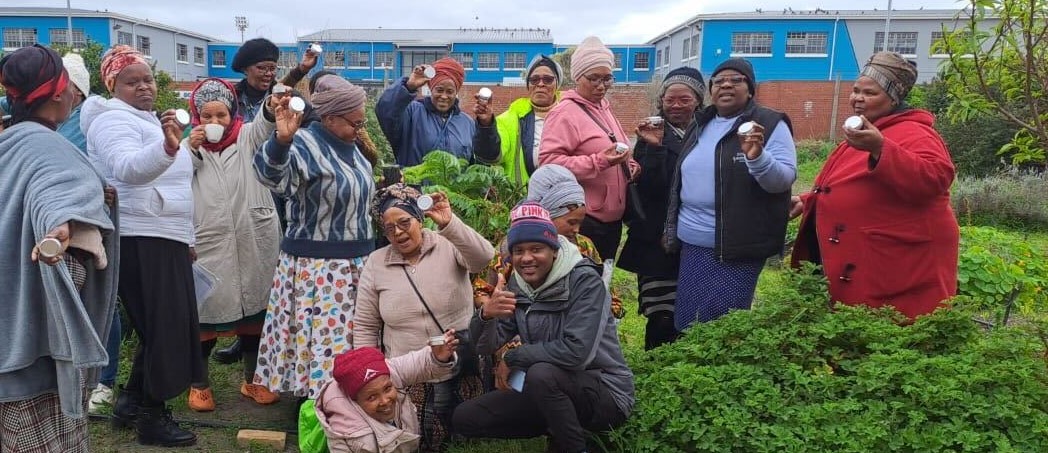
A year-long programme aimed at improving the health, well-being, and economic resilience of urban farmers in Khayelitsha showed promising results. The Environmental Entrepreneurship and Social Innovation (EESI) initiative, which ran from April 2024 to March 2025, brought together over two dozen participants, primarily women and backyard farmers, to reimagine nutrition, biodiversity, and entrepreneurship through targeted workshops.
The EESI programme, funded by the Global Risk Governance Programme at the University of Cape Town and implemented in partnership with the SA Urban Food & Farming Trust (SAUFFT), is focused on creating biodiverse green spaces, improving nutritional self-sufficiency, and supporting green entrepreneurial opportunities.
In the previous year, eight workshops formed the heart of the programme, covering topics from health and nutrition to herbal medicine, agro-processing, and entrepreneurship. Participants explored wild edibles, made salves and herbal teas, and received propagation and mushroom cultivation training. The workshops were designed to be practical and culturally resonant, introducing farmers to useful indigenous plants like wild rosemary, sandkool, and dune spinach.
Workshop feedback indicated strong community engagement. Participants appreciated hands-on activities, especially sessions that involved food preparation and herbal remedies. Notably, the workshop on growing imino (traditional leafy greens) and oyster mushrooms was named a favourite, with many farmers successfully incorporating mushrooms into their diets.
Several key themes emerged throughout the programme. Firstly, nutrition knowledge among participants improved significantly. Endline surveys revealed a wider variety of foods in daily diets, increased consumption of dark leafy greens, and reduced reliance on processed staples. Herbal teas replaced sugary drinks for some, and homegrown produce began to supplement supermarket purchases, improving household food security.
Secondly, the programme helped spark renewed interest in indigenous knowledge. Farmers with limited prior experience with herbs became more confident in growing and using them for nutrition and medicine. The propagation of medicinal and culinary herbs, including rosemary, basil, and thyme, was coupled with practical demonstrations in salve and chutney making, reinforcing the value of local plants in everyday wellness.
While most participants gravitated toward the health benefits of the workshops, the programme also identified five farmers with strong potential to explore income-generating opportunities through herbal products. In collaboration with ORIBI and Harvest of Hope, a dedicated entrepreneurship session introduced participants to cooperative models and provided basic business training. These early steps paved the way for a longer-term market access strategy, though facilitators acknowledged that such development requires sustained investment.
Challenges were not absent. Recruitment was more difficult than anticipated, and a key mentor’s early departure initially disrupted momentum. Budget constraints also meant fewer material resources could be shared, and the programme had to rely on in-house catering and local partnerships. Flooding and economic pressures led to some dropouts, especially as farmers sought alternative income opportunities.
Despite these hurdles, facilitators Nomalanga Ruiters and Mzikabawo Mashicila noted the programme’s profound personal and professional impact. “We shifted from giving out resources to offering knowledge. Cooking and practical demonstrations made learning more relatable and impactful. It was powerful to see how farmers began to understand the value of plants not just for food but also for health and income generation.” said Nomalanga.
Mashicila, who stepped into a facilitation role, reflected: “I started unsure, but I grew into a confident teacher and leader. The farmers appreciated my contribution, and that helped me see the impact of what I was doing.” He also highlighted a renewed focus on herbal healing in his personal life. “I’ve chosen to dedicate my garden in Langa to herbs. I want to reintroduce this knowledge to the community to heal and reconnect.”
As the project has concluded, efforts are underway to secure further funding and expand the initiative across SAUFFT’s broader Agrihub network, reaching up to 1,200 farmers. Proposals include introducing more climate-resilient indigenous crops and integrating agroecological practices to strengthen nutrition and adaptation strategies.
The EESI programme has shown that with the right tools, support, and respect for traditional knowledge, small-scale farmers can lead a transformation toward healthier, more resilient urban food systems.
 SA Urban Food & Farming Trust