
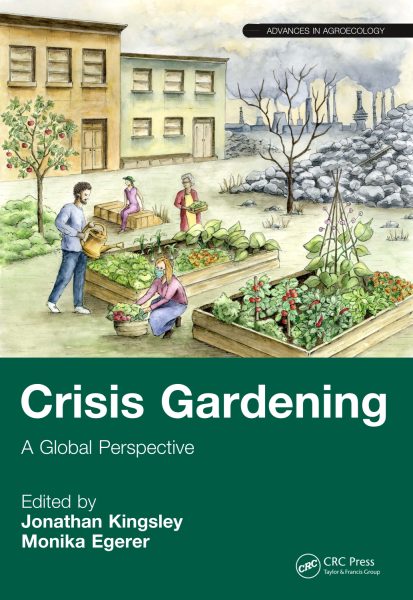
Crisis Gardening – A Global Perspective, presents an in-depth exploration of how communities are reimagining food systems amid persistent crises. This work challenges conventional approaches and encourages a reflective examination of urban agriculture practices as strategic responses to social, economic, and environmental instability.
Structured in three broad sections, the book first defines and explains crisis gardening in relation to agroecology, transformative change in food systems and public health. It next describes case studies from around the world of crisis gardening from various social-ecological perspectives. The volume closes with policy and practice recommendations and how to scale up the lessons from crisis gardening to transform food systems, public health systems, and policy and landscape planning processes.
One of the featured case studies investigates the situation in Cape Town, where enduring challenges have spurred the emergence of innovative urban agriculture initiatives. The chapter examines the Langa Agrihub, a community-led project supported by the South African Urban Food and Farming Trust. This initiative demonstrates that while economic pressures often drive citizens to engage in farming as a means of survival, the social and communal benefits that arise are equally significant.
Using an extensive literature review alongside qualitative methods—including site observations, semi-structured interviews, and interactive workshops—the authors reveal how participation at the Langa Agrihub is fostering a network of local resilience. Residents are not only adapting their agricultural practices to better cope with crises, but they are also actively shaping community decisions and strengthening market connections within Cape Town. These processes are redefining urban food systems, promoting healthier nutrition choices, and encouraging local innovation.
By presenting these findings, Crisis Gardening – A Global Perspective invites readers to consider how grassroots initiatives can serve as effective coping strategies during times of multifaceted crisis, or polycrisis. The book offers a thoughtful perspective on reconfiguring urban agriculture and underscores the potential for local communities to lead transformative change in their food systems.
These insights are invaluable for scholars, practitioners, and policymakers. Analysing the interplay between economic necessity and community solidarity, this research deepens our understanding of urban resilience while emphasizing grassroots innovation’s potential to reimagine food systems.
The book is part of the book series Advances in Agroecology , which has a storied 25 year publication track record. The books in the series, published by for Routledge Taylor & Francis, span a diverse range of topics while the readership is international, with authors and editors from across the globe, targeting academic researchers, professionals – from ‘on-the-ground’ practitioners to policy makers – and graduate level students. Advancing ecological, political, social and environmental change since the first book published in 1998, this series continues to aid the transition of our current food system to new farming practices that mitigate climate change and prioritise local supply chains.
To learn more and purchase a copy: Crisis Gardening – A Global Perspective.
“The Langa Agri-Food Hub: Strengthening farmers’ networks and transforming food systems in crisis in Cape Town, South Africa.” Authors Urrego Diaz N, Ley A, Ackermann K, Fischer L., in Crisis Gardening: A Global Perspective, edited By Jonathan Kingsley, Monika Egerer. Published by Routledge CRC Press (2025), ISBN 9781032564067.
 SA Urban Food & Farming Trust