
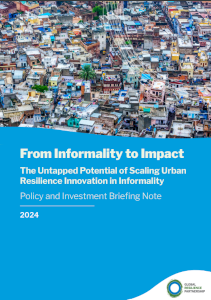
The latest Global Resilience Partnership report, “From Informality to Impact: The Untapped Potential of Scaling Urban Resilience Innovation in Informality,” launched at the UN’s World Urban Forum this week.
The report identifies key opportunities and challenges for scaling urban resilience solutions in informal contexts, as well as recommendations for policy and investment approaches that help those solutions to scale.
The SA Urban Food and Farming Trust was pleased to contribute its own experiences and insights from working with over 1200 informal farmers in vulnerable urban communities, and to see strong correspondence between the recommendations of the report drawn from 130 other contributors from across the Global South and our own assessment of the way forward.
In particular:
- The moment is now. There is a consensus case for action in addressing urban resilience in informal contexts and we have all been learning by doing, but are at the transition point to scale.
- Traditional funding mindsets will not unlock the innovations shaping a resilient future. Innovative and hybrid funding solutions are required and will be the norm in order to get solutions fully implemented at scale, maximising their impact.
- Resilience to climate shocks and stresses has impact beyond climate. Investments in urban resilience in informal contexts bring a wide range of benefits in addition to climate, from health to livelihoods, gender equity to biodiversity, nutrition, safety, and more.
The report also makes the case for why informal contexts are so important, why finance for climate adaptation is key but remains inadequate, and, importantly, that what finance is available is almost all locked up in local governments who lack capacity to make effective use of it.
In other words:
- Government needs partners if we are going to build meaningful resilience.
- Funders need to look beyond government to achieve impact.
- And non-profits are more engaged and collaborative, working via community-driven approaches.
This highlights the importance SA Urban Food and Farming Trust’s work scaling the Agrihub Initiative to strengthen the resilience of over 1 000 000 vulnerable urban residents in South Africa in the next 10 years.
Read the full report.
 SA Urban Food & Farming Trust